
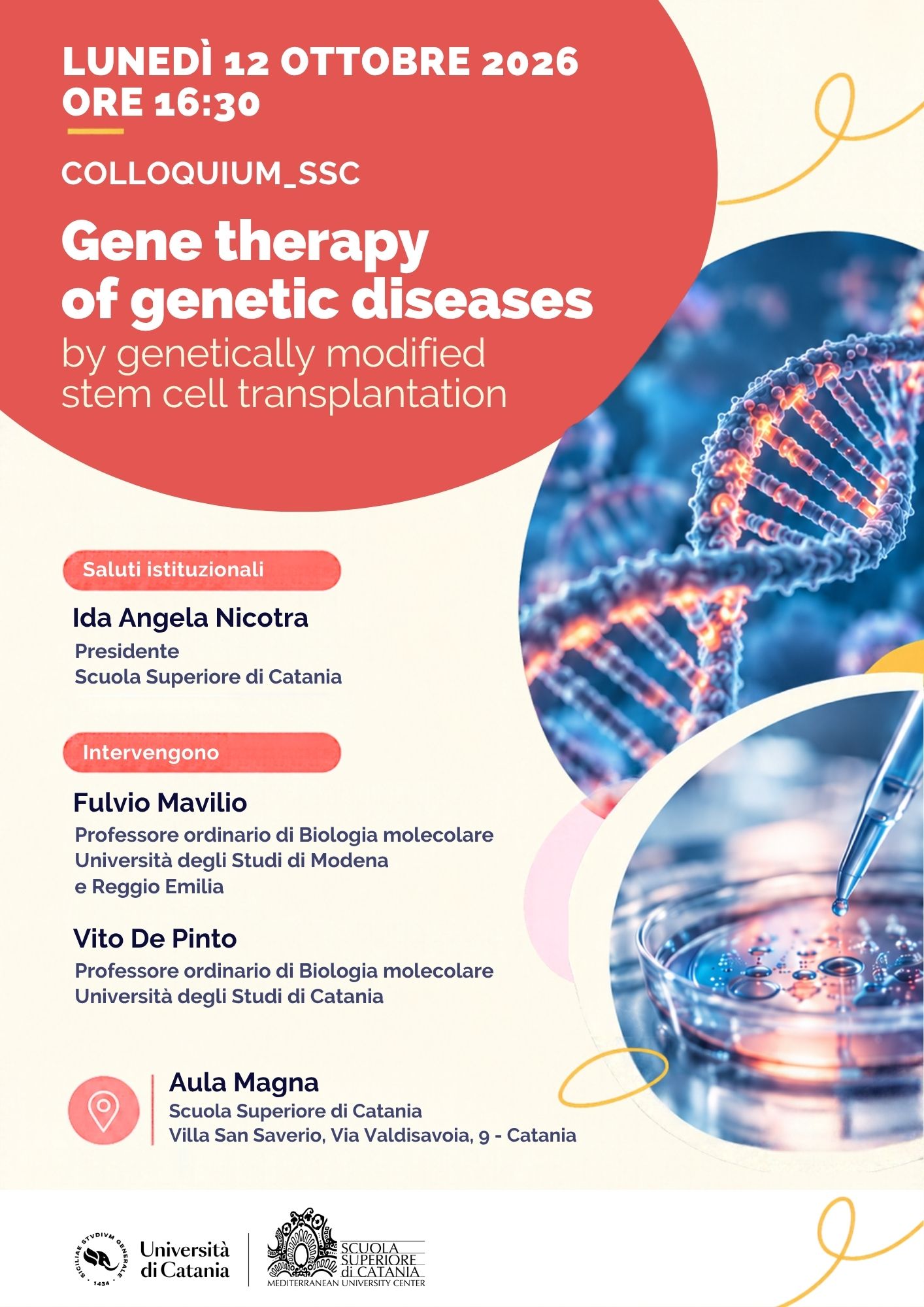
Incontro programmato fra le iniziative promosse dall’Università di Catania nell’ambito del Festival dello Sviluppo Sostenibile 2025
12 ottobre 2026 | Ore 16:30
Ex Cappella – Villa San Saverio, Via Valdisavoia 9 (CT)
FULVIO MAVILIO – Professore ordinario di Biologia molecolare, Università degli Studi di Modena e Reggio Emilia
Fulvio Mavilio is affiliated with the University of Modena and Reggio Emilia in Italy. Their research primarily spans the fields of Biochemistry, Genetics, and Molecular Biology, with significant contributions also to Medicine. Within these broader areas, their work focuses on key subfields such as Genetics, Molecular Biology, Immunology, Physiology, and Hematology.
The topics explored in their publications cover a range of biomedical research areas, including:
- Hemoglobinopathies and Related Disorders
- CRISPR and Genetic Engineering
- Virus-based gene therapy research
- Lysosomal Storage Disorders Research
- Muscle Physiology and Disorders
- Neurogenetic and Muscular Disorders Research
- Iron Metabolism and Disorders
Fulvio Mavilio has contributed to several recent papers, highlighting advancements in gene therapy and genetic editing technologies. Notable works include:
“Editing a γ-globin repressor binding site restores fetal hemoglobin synthesis and corrects the sickle cell disease phenotype,” published in 2020 in Science Advances
“Safety and efficacy of gene replacement therapy for X-linked myotubular myopathy (ASPIRO): a multinational, open-label, dose-escalation trial,” published in 2023 in The Lancet Neurology
“Designing Lentiviral Vectors for Gene Therapy of Genetic Diseases,” published in 2021 in Viruses
“Correction of β-thalassemia by CRISPR/Cas9 editing of the α-globin locus in human hematopoietic stem cells,” published in 2021 in Blood Advances
“Muscle-directed gene therapy corrects Pompe disease and uncovers species-specific GAA immunogenicity,” published in 2021 in EMBO Molecular Medicine
These publications have appeared in a variety of scientific venues. Among the frequent journals in which this researcher publishes are:
- Blood
- Gastroenterology
- Molecular Genetics and Metabolism
- Neuromuscular Disorders
- Science Advances
Collaboration is evident in their work with several frequent co-authors, including:
- Anne Chalumeau
- Annarita Miccio
- Marina Cavazzana
- Mario Amendola
- Michael W. Lawlor
Evento aperto al pubblico.
ABSTRACT
Thirty-five years ago, genetically modified bone marrow cells were administered for the first time to a child suffering from severe combined immunodeficiency, a rare and lethal disorder of the immune system. This pioneering treatment, entirely developed in Italy, was the result of the clinical translation of many years of research on a simple concept: inserting a copy of a normal gene in a cell where the function of that gene is lacking or not sufficient. Actually, not exactly in the cells where that function is needed, but rather in a transplantable stem cell that can give rise to a population of those cells for the patient’s lifetime. Since then, a series of authoritative clinical studies proved that transplantation of genetically modified hematopoietic stem cells (HSCs) can cure not just immunodeficiencies, but metabolic diseases, lysosomal storage diseases, neurodegenerative diseases or hemoglobinopathies, and transformed stem cell gene therapy into a clinical reality.
The HSC gene therapy technology is based on the use of genetically engineered viral vectors to transfer a functional gene “cassette” into HSCs obtained from the bone marrow of a patient or mobilized into peripheral blood by appropriate drug combinations. HSCs are then purified, transduced by a viral vector outside the patient’s body, and re-administered to the patient after appropriate bone marrow conditioning. The technology was conceived as a genetically modified version of autologous HSC transplantation, a well-established therapeutic intervention developed in the mid-1950s for the treatment of leukemias and lymphomas. Many years of clinical development have demonstrated the safety and efficacy of HSC gene therapy, eventually leading to commercially available therapies such as Libmeldy® for metachromatic leukodystrophy, Skysona™ for cerebral adrenoleukodystrophy, and Zynteglo™ for beta-thalassemia and sickle-cell disease. Many more therapies are currently in different phases of clinical development, addressing a wide range of diseases.
Recently, a new generation of technology has emerged, aimed at correcting the genome rather than replacing a defective gene function. This technology relies on enzymes capable of introducing mutations directly in the HSC genome, to either repair a mutation or activate the function of a compensating gene. One such therapy, Casgevy™, has been marketed at record speed in the US and EU as a second-generation gene therapy for beta-thalassemia and sickle-cell disease. HSC genome editing may overcome at least some of the limitations of viral vector-based, classical gene replacement therapy, and provide additional therapeutic opportunities. However, not all diseases are addressable by editing technology, which anyway does not solve the complex logistics and manufacturing challenges inherent to a transplantation approach. These are still early days for the clinical application of direct genome manipulation, and its long-term safety has yet to be proven in the clinical reality.
HSC gene therapy products have been developed so far for rare or ultra-rare indications. As I will discuss in my presentation, the same concept and the same technology can be extended to less rare or non-rare diseases, by exploiting the ability of specific HSC progenies to deliver gene products in many different organs and provide cross-correction of cells in those organs by different cell transport mechanisms.
Autologous HSC gene therapy is patient-specific by definition, and gene modified HSCs are manufactured using GMP-compliant technology that is complex, expensive and challenging to commercialize. Applied to rare diseases, where the patients’ basis is limited in size, this translates into high prices, limited diffusion and modest revenues for the developers. In reality, these factors have discouraged investment in more efficient and economical manufacturing technology, and further expansion to large indications that require robust industrial processes. A change of paradigm by industry and regulators and new commercialization models are necessary to overcome these hurdles, which are drastically limiting access to safe and unprecedently efficacious medicines to patients suffering from otherwise incurable rare diseases.